
Specialty · Applied artificial intelligence
AI integration in the Canary Islands.
Practical AI applied to real installations — buildings, hotels, industry — across the Canary Islands. Not AI for the hype, but where it produces measurable value: energy savings, fault anticipation and simpler operations.

What we do in applied AI in the Canary Islands
AI for buildings and hotels
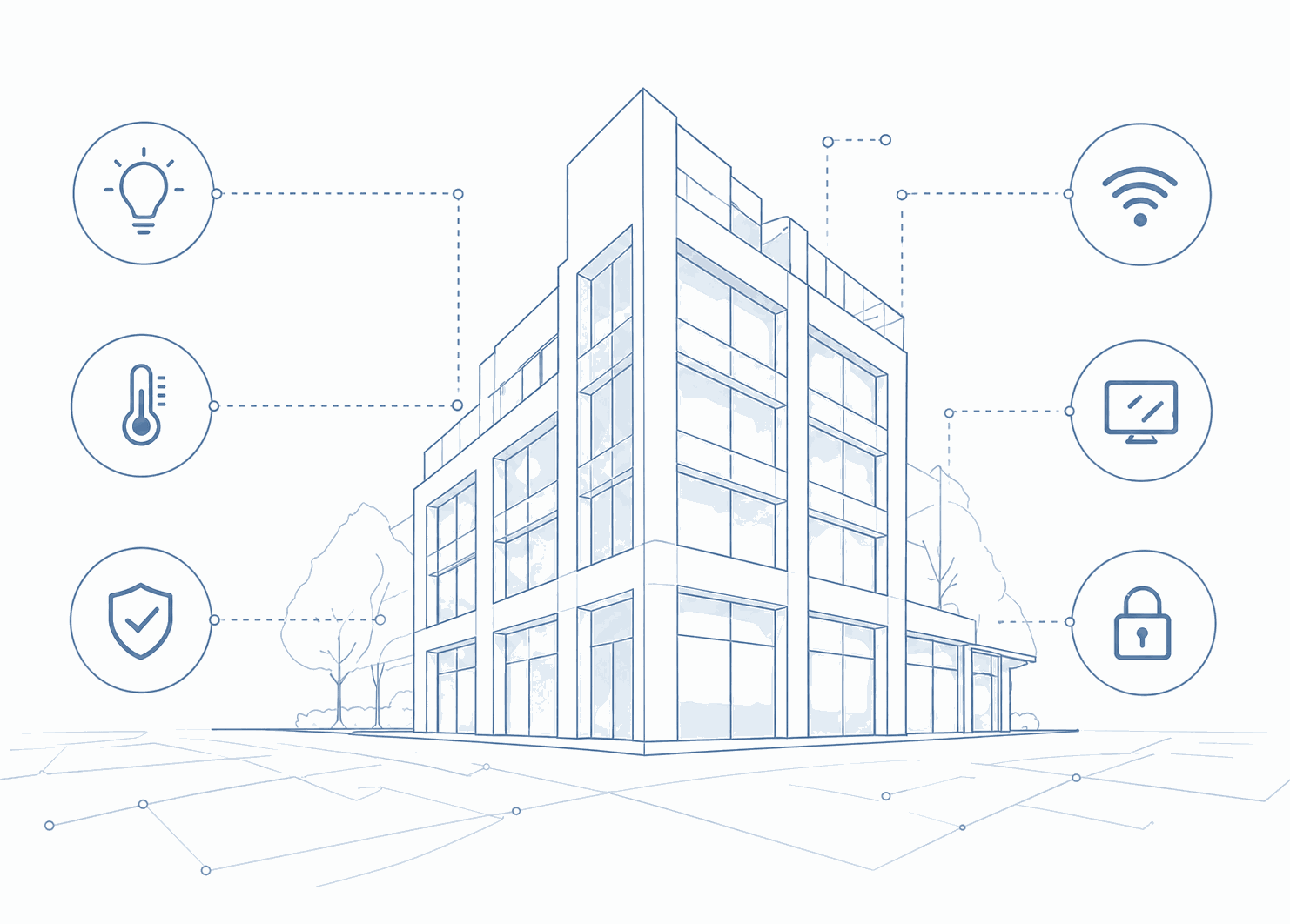
Energy demand prediction by occupancy and weather, adaptive HVAC based on real usage patterns, consumption anomaly detection and automatic incident reports to CMMS. Direct integration on top of existing KNX or BMS.
AI for industry
Predictive maintenance from PLC variables, process anomaly detection to avoid defective batches and setpoint optimisation in lines with multiple degrees of freedom. Connected to SCADA and MES/ERP via OPC UA.
AI for energy
Consumption forecasting by end use, matching with PV generation and hourly pricing, identification of demand response opportunities and automated reporting for ISO 50001 audits and energy certificates.
Voice assistants and LLMs
Conversational assistants on LLMs (Claude, GPT-4, Gemini) with access to KNX/BMS state — natural language commands, contextual technical queries, building FAQ and escalation to humans when needed.
Why add AI on top of your installation
Without scrapping what you have
AI integrates on top of the existing KNX/BMS, SCADA or energy meter. The installation keeps working as before, even if the AI layer goes down. It's not a replacement, it's an extension.
Edge when data matters
Deployment on a NAS or local mini-server inside the building or plant, with no outbound traffic. Compliant with GDPR, internal client policies and IP restrictions. The cloud is used when it helps, and only when it helps.
Clear metric from day one
We don't sell pilots without a measurable use case. Before touching anything we define which metric improves (% energy savings, hours of breakdown avoided, defective batches caught) and report monthly. If the indicator doesn't move, we don't continue.
Remote operations from Tenerife
AI is the easiest layer to operate remotely: once deployed, the model and the dashboard live on the client's server, and from Tenerife we monitor, tune and retrain without inter-island travel.
Typical use cases
Hotel
Predictive HVAC per room
A model that learns from real usage (PMS occupancy, check-in time, weather, thermal inertia) and pre-conditions the room before arrival. 15-25% savings versus fixed schedules.
Industry
Predictive maintenance of pumps
Model trained on motor current, vibration and bearing temperature. Warns 2-4 weeks before failure. Automatic ticket to CMMS.
Tertiary building
Consumption anomaly detection
Per-circuit submetering + baseline model. When a circuit deviates from its usual pattern, immediate alert: water leak, blown lamp, equipment left on by mistake.
Premium home
Contextual voice assistant
LLM with access to KNX state. Natural-language commands ("dim the living room lights to 30% and turn on the fireplace"), no pre-programmed scenes, native multilingual.
Energy management
PV match + hourly pricing
Model that predicts PV generation for the next 24-48h and shifts loads (DHW, HVAC, EV charging) to surplus windows. Optimises self-consumption and the bill.
Operations
Building technical FAQ
LLM with access to the maintenance manual, incident history and BMS state. The maintenance technician asks and gets immediate answers without digging through PDFs.
Typical stack
Frequently asked questions
What we're asked the most about AI integration in the Canary Islands.
What do you mean by "AI integration" in a real installation?
We don't sell chatbots or "hype AI". We work on top of the data the installation already produces — consumption history, occupancy, HVAC, process sensors, security video — and apply models that deliver measurable value: anticipating energy demand, detecting anomalies before failure, conditioning rooms based on real patterns, in-line quality control or automating first-level support. AI integrates on top of the existing KNX/BMS or SCADA, it doesn't replace them.
Do I need to replace my current KNX, BMS or SCADA to add AI?
No. AI is built as a layer on top of what already exists: we read variables via KNX-IP, BACnet/IP, Modbus TCP or OPC UA, store them, model them and send setpoints or alerts back to the existing system. The installation keeps working even if the AI layer drops. That "non-intrusion" is deliberate — a KNX/BMS system running for 5-10 years is the foundation, not something to throw out.
Will my data go to Google's cloud, OpenAI or any third party?
Only if you decide so. All time-series models (consumption forecasting, anomaly detection, adaptive HVAC) run on the edge on a NAS or local mini-server in the building or plant. LLMs (Claude, GPT-4, Gemini) are used via API only when the case justifies it, and always with anonymised or conversational data. In sensitive installations (hospitals, institutional buildings, industry with IP) we work full-edge with no outbound traffic.
Which use cases make sense in a hotel or tertiary building in the Canary Islands?
Three with clear ROI: 1) Energy demand prediction by occupancy + weather, to match it with the PV curve and the hourly PVPC price; 2) Adaptive HVAC based on real usage patterns of room or hall, instead of fixed schedules — typically 15-25% savings in HVAC; 3) Detection of water and energy consumption anomalies per circuit (leaks, faulty equipment, wrong staff settings). For hotel chains, also automatic CMMS ticketing with incident prioritisation.
And in industry? What can be done with AI on a production process?
Predictive maintenance from PLC variables (temperature, vibration, current, pressure) — we train models on the plant's real history and warn when the pattern deviates before failure. Process anomaly detection to avoid defective batches. Setpoint optimisation in lines with multiple degrees of freedom (flows, pressures, temperatures). Integration with SCADA and with the client's ERP/MES via OPC UA or REST.
How much does it cost to start an AI pilot project?
A pilot always includes the same: audit of available data, definition of measurable use case, trained and validated model, integration with the existing system and a tracking dashboard. The scope and cost vary significantly with the complexity of the use case, the starting data and the integration needed. We deliver a custom study with no obligation — define the use case and we come back with a fixed proposal and a clear success metric. If it works, we scale with an operations contract.
Do you work with voice assistants like Alexa or Google Home over KNX?
Yes, but with caveats. Standard KNX IP gateways allow voice control from Alexa, Google Home or Apple HomeKit. For advanced cases (complex natural-language queries, building context, multi-language, integration with the maintenance manual or ERP) we build our own assistants on LLMs (Claude, GPT-4, Gemini) with access to KNX/BMS state. Voice is one more layer — useful when it adds value, dispensable when it doesn't.
Does Indótica work all over the Canary Islands or only in Tenerife?
Office in Santa Cruz de Tenerife. AI projects, by their nature, are the easiest to operate remotely: once deployed, the model and dashboard live on the building or plant's own server, and from Tenerife we monitor, tune and retrain without travel. For work that does require physical presence (new wiring, additional sensors) we cover Gran Canaria, Lanzarote, Fuerteventura, La Palma and La Gomera.
AI pilot
Got an installation to apply AI on?
Tertiary building, hotel, industrial plant or premium home in the Canary Islands: tell us the data you already produce and the use case you have in mind. We'll come back with a pilot proposal, a clear success metric and a fixed budget within 48 hours.